A pre-built instant estimate calculator, branded with your company name and your prices. A homeowner answers five questions and gets a real Cape May County range in about a minute — and you get the lead with the project scope already attached.
Try the live demo → Get a free sample
Or we'll build one free with your name on it → · That demo is real and public. It is branded for a Cape May painting company and uses local pricing, not a national average.
A homeowner decides they want the house painted. They open Google, tap three or four painters, and spend ten minutes on each site. Almost every one of those sites gives them the same thing: a phone number, a paragraph about quality, and a form that says "request a free estimate." So they fill out the form, or they don't, and then they wait. Most of them don't wait long.
Here is what they actually wanted, and it's the reason they left your site: a ballpark. Not a firm price, not a contract, not a promise. A range. Is this a three-thousand-dollar job or a twelve-thousand-dollar job? That single question is why most painting websites leak traffic, and almost none of them answer it.
The painter on the other end knows exactly why this is expensive. The phone rings, you ask a few questions, you drive out, you spend forty minutes walking a house, you write it up — and then you hear that the homeowner was expecting something a third of what a Shore exterior actually costs. You didn't lose that job because your price was wrong. You lost it because nobody set the expectation before you burned half a tank and an afternoon.
Meanwhile, the homeowners who weren't ready to talk to a salesman yet — the ones planning for spring, or waiting on a bonus, or just trying to figure out whether they can afford it at all — those people were the biggest half of your traffic, and they left without leaving a trace.
Contractors are usually confident they catch their calls. The survey work says otherwise, and the gap is the whole reason this product exists.
Read those four together and the sequence is short. The phone rings while you're on a ladder. You don't get it. They don't leave a message, they don't call back, and they hire whoever picked up. Nothing in that chain was about your price or your work — it was about a call nobody could answer because both of your hands were full.
Which means the site's job isn't only to get the phone to ring. It's to capture the homeowner who would rather not call at all — the one who wants a number at 9pm on a Sunday, and who currently gets nothing from a painting website except a form that promises to "get back to you."
Sources: Service Direct home service call performance report and 2022 homeowner survey; Forbes (2024) and Invoca (2024) on voicemail abandonment; PATLive (2024) on unreturned missed calls. These are home-services figures as a whole, not painting-only.
None of these are about your work. All of them are about the gap between a homeowner who's interested and a homeowner who signs.
Every one of those six gets worse the moment a homeowner leaves your website without telling you anything. Which is what most of them do.
It's a Tuesday in June. You've got a crew at a house in Avalon and a second at a job in Court House. Your phone buzzes in the truck: three missed calls, one voicemail, two texts. You listen to the voicemail while you're waiting on a paint order — a woman in Sea Isle wants a quote on a two-story exterior, "whenever you can get out here." You write her name on the back of a receipt.
She called two other painters in the same ten minutes it took you to stop working and answer. One of them called her back in four minutes. That one is going to walk the house Thursday, hand her a number Friday, and book it. Not because their work is better than yours. Because they were the first to sound like a real business instead of a voicemail box.
Now the part that really costs you. Six weeks ago you spent an hour on a written estimate for a house in Dennis Township. Nice people, wanted an interior repaint before their daughter's wedding. They said the number was "more than we expected" and you never heard back. You assumed it was a no. It wasn't. They painted the living room and hallway in March with a guy they found in a Facebook group, and they paid about what you quoted — they just didn't have the money in October, and nobody stayed in front of them until they did.
That's the whole problem, and it isn't a sales problem. You've got no way to stay in front of somebody for six months without being annoying. So the work goes to whoever happened to be in the right inbox at the right moment, and that's a coin flip you lose twice: once in October, once in March.
And then January comes. The phone goes quiet, the crew needs hours, and you're at the kitchen table trying to remember who ever said "check back with me in the spring" — except you can't, because you wrote it on a receipt.
The calculator asks five questions, in the order a painter would actually ask them. What are we painting — interior, exterior, or a deck. How big, and for exteriors, how many stories. What condition the surfaces are in. What paint tier they want. And when they're thinking about doing it. That's it. No address, no phone number, nothing until they've already invested about thirty seconds of their own effort.
Then it shows them a real range, built from South Jersey labor and material pricing — not a national survey that says a house costs "$2,000 to $5,000" and helps nobody. It also shows them the breakdown, so they can see that prep is a line item and not something you invented. That single piece of education does more for your close rate than any amount of copy about craftsmanship, because it stops the sticker shock before it starts.
Every question is doing work. The condition question sets up why a chalky, peeling exterior costs more than a sound one. The stories question handles the labor reality of a three-story Victorian in Cape May. The paint tier question shows a homeowner that premium product is a choice with a reason behind it, not an upsell you're springing on them later.
The range is honest on purpose. It's a range, and the page says so out loud, because anyone quoting a firm number over the internet without standing in front of the house is guessing and hoping you don't notice. Homeowners trust a range that admits what it is far more than a number that pretends to be exact.
After the range, they can ask for a free two-page report on their own house. It goes out by email in under a minute, branded with your company name, your phone, your colors. It carries their range, a surface-by-surface read on what the answers imply, how many years a finish actually lasts in salt air, what drives the price, and five questions to ask any contractor before signing.
Why does a painting contractor need to send a report? Because painting is not an urgent purchase. Nobody wakes up in a panic about their siding. They shop for weeks — often months — and they buy when something triggers it: a spring calendar, a leak, a listing photo, a neighbor's new roof, a family event. The painter who wins is almost never the cheapest or the fastest. It's the one who is still in the inbox on the month the homeowner finally decides.
That's why the report also asks one question the rest of the industry doesn't ask: when do you expect to do this? Now, within 30 days, one to three months, or just researching. A homeowner who says "spring" is not a dead lead. It's a phone call you get to make in March with a reason attached, instead of bothering them in November and getting ignored.
Every homeowner who uses the calculator goes onto a once-a-month email sequence for the following year, written for painting. What actually moves a paint price. Why the cheapest bid costs the most. When the Shore painting window opens. Anyone who says "now" gets flagged to you the same day. Anyone who replies — even "not yet" — stops the sequence immediately, because a real reply is worth more than any automation.
A lead arrives with the work already qualified: name, phone, email, ZIP, interior or exterior, square footage, stories, condition, paint tier, add-ons, the range they were shown, and the month they said they'd buy. You know before you dial whether this is a two-thousand-dollar interior refresh or a twenty-thousand-dollar three-story exterior, and whether to call today or put it on the spring list.
That's the difference between a contact form and a lead. A form tells you someone exists. This tells you what they want, what they can probably afford, and when. When a lead comes in, you get an email immediately — and the homeowner gets their report at the same moment, which is the reason they remember which painter actually answered.
Owners tell us the two things they hate about their own website are that it generates tire-kickers and that it generates silence. Both of those come from the same gap: no number, no expectation, no follow-up. This closes all three in about a minute of a homeowner's time.
This isn't a mockup. Below is the working calculator, branded for a Cape May painting company, and the two-page report that lands in a homeowner's inbox about a minute after they finish it. Everything you see is built from their answers and local pricing.
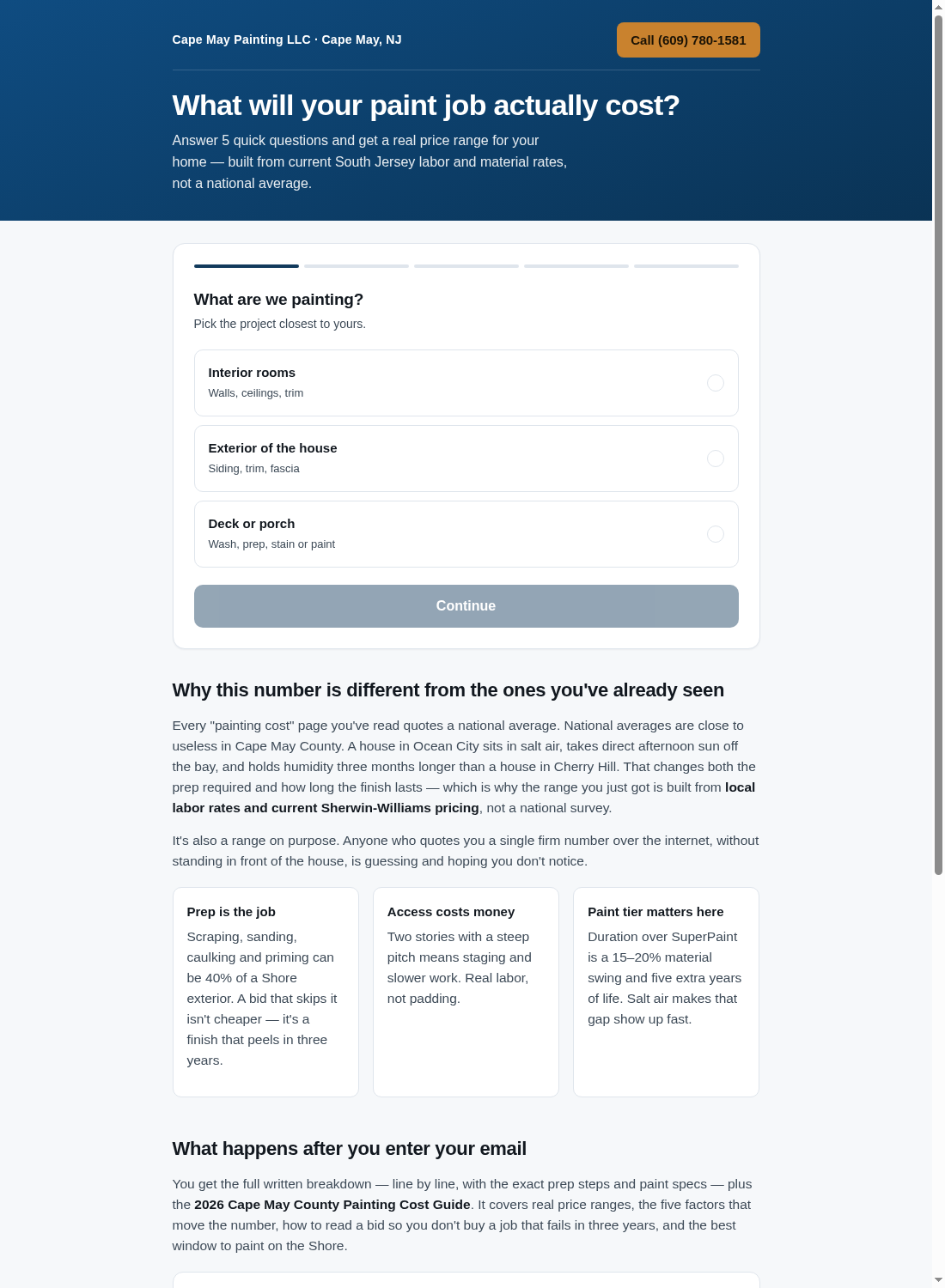
Click the image to use it yourself. Five questions, no form until the end.
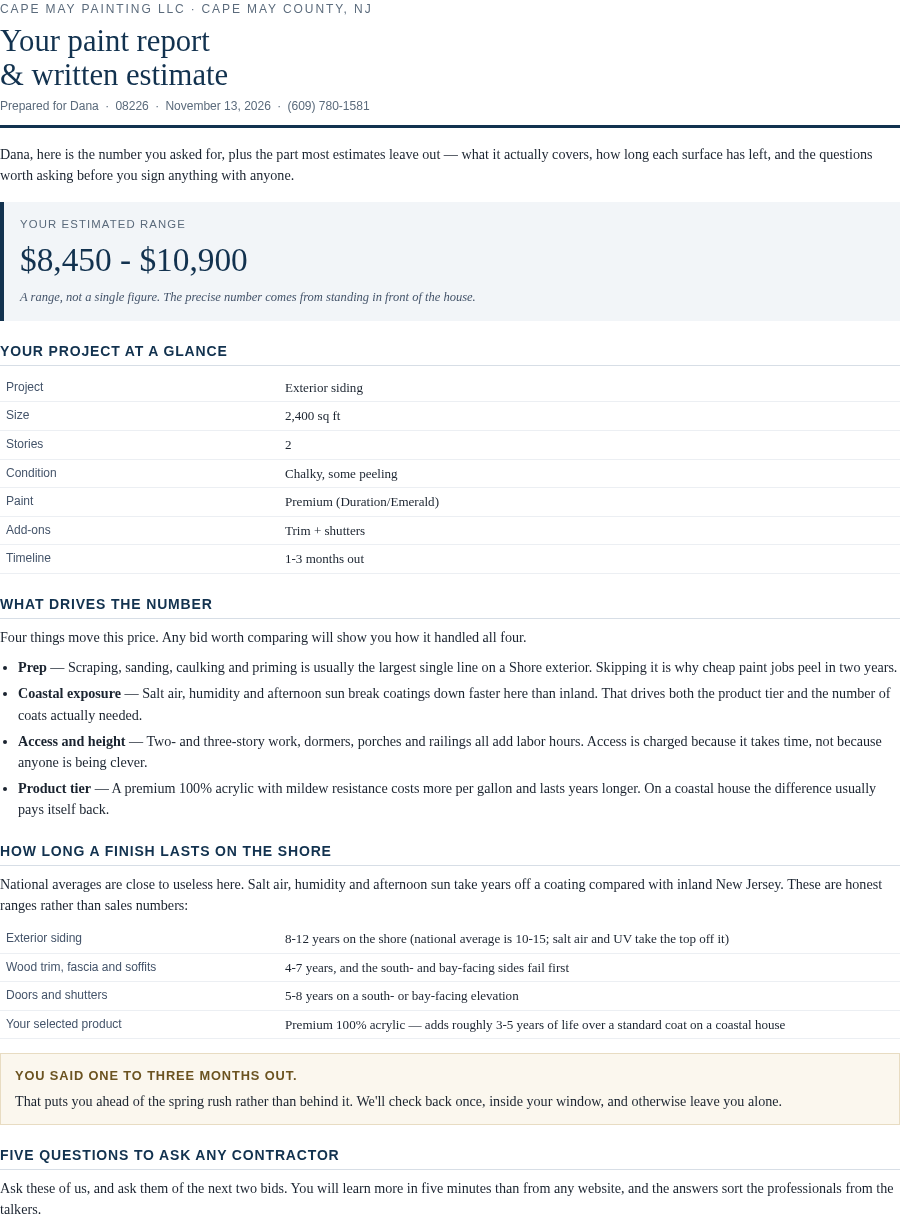
Two pages, their number, their project, your name and phone. Click to open the real PDF.
Same calculator, running live. This is the embed version — on a real client site it sits on their own subdomain instead.
You shouldn't have to imagine this. Send us three things and we'll build a working version for your company at no cost, with no card, no contract and nothing to cancel:
Two business days later you get a live link with your name on it, plus one test lead you can run through yourself. Not a screenshot, not a video, not a "book a demo call" — the actual working page, on your own rates. If you don't like it, you say so and that's the end of it.
Why we do this: every painter we've talked to has been burned by a marketing pitch that took a deposit and delivered a PDF. The only thing that proves this works is the thing itself, running on your prices. If it isn't obviously worth $97 a month once you've got it in your hands, it shouldn't be worth it on our word.
Reply to any email from us, or use the contact page and write "sample" in the message. Fifteen minutes of your time, two days of ours.
Request my free sample → Or email the details →You don't give us your WordPress or Wix login. You don't call your web guy. You don't need to know who hosts your domain. The calculator lives on its own address — estimate.yourcompany.com or similar — and the only change is pointing your existing "Get an Estimate" or "Free Quote" button at it. One line, one link, done.
If you'd rather it sit inside the site you already have, that's possible too. We've built and tested the embed, and it resizes itself to the page. But the subdomain is what most painters prefer, because it's independent of whoever built their website and it can't break.
We do the setup. You send us your rough rates — per square foot for interiors, per square foot for exteriors, per square foot for decks — and we build the rate table around them, brand the page, connect the leads to your inbox, and test it with a real submission before we tell you it's live. If your prices change next season, you tell us and we update them.
one-time setup
The first 30 days are free. One closed interior repaint covers a full year of the monthly fee, and most painters do more than one interior job in a year. If it produces nothing in the first month, you've spent a month of attention and no money.
It is not a replacement for your website, and it won't fix a site that's broken on a phone. It is not a lead-selling service — the leads are yours, we don't resell them, and we don't run ads for you. It is not an estimating tool that gives firm prices, because a firm price without seeing the house is a guess dressed up as a quote.
And it won't book jobs by itself. What it does is stop the two leaks that cost painters the most: homeowners who leave without a number, and homeowners who were interested but not ready yet. Those are the two halves of your traffic you currently have no way to keep.
No. The calculator lives on its own address, like estimate.yourcompany.com, and you point your existing Get an Estimate button at it. Your site stays exactly as it is, and no one needs your web guy.
No. It sits alongside whatever you already have. Most painters keep their current site and use this as the destination for anyone who wants a number.
You do. Every lead goes to your inbox as soon as it comes in, with the name, number, address, project details and the month they said they would buy. We do not resell them, and they are exportable if you ever leave.
Tell us and we update the rate table. It's part of the monthly fee and it takes a day, not a project.
The first 30 days are free, so the only thing you spend is attention. If you cancel after that, you keep every lead it generated, including the ones who said they'd buy in the spring.
No. It's a range, and the page tells the homeowner that plainly. The firm number still comes from standing in front of the house, which is where it should come from.
Yes. The questions, the pricing logic and the report are all built for residential painting in Cape May County — salt air, pre-1978 lead-safe rules, three-story shore houses and all. We have the same engine for other trades, but this version is yours.
The demo below is a real, working calculator, branded with a Cape May painting company. Use it the way a homeowner would — pick exterior, put in a square footage, look at the range, and request the report. That report is the exact thing your homeowners would get.
The full flow, end to end, about sixty seconds.
Open the live calculator → See the 2-page report (PDF) →If you want one built with your name on it, the setup is fifteen minutes of your time and a day of ours. Reply to any of our emails, or use the contact page — a real person reads it.